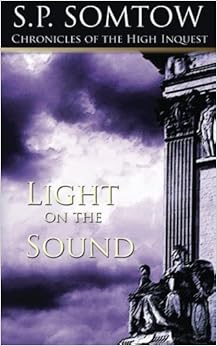
I'm going to be completely honest with people here, I'm not entirely sure what to think of this book. You see, I initially read this book on a sort of self-imposed challenge. A good friend of mine sort of vaguely mentioned this book series she referred to as The Inquest, which no one else she'd ever met had read or even heard of. Her boyfriend and I even joked that perhaps the series was an elaborate hoax on the part of her parents since it seemed to be that obscure. Heck, the ever-venerable TV Tropes where I stumbled across the Bolos has absolutely nothing regarding Chronicles of the High Inquest. I eventually had to wring my friend's arm to give me more information so I could track these books down and finally, perhaps miraculously, found a reprinting from 2013 available on Amazon. And so, flushed with the success of having found the damn thing, I went ahead and read the first of four books in this series.
The result is now that I'm in a very delicate situation and I'm not really sure what to say about this book. My friend is a very big fan of this series, perhaps for reasons which will be revealed in later books, but I have yet to be certain about that. However, this book has been out of print for nearly thirty years and so that leaves my blog in a position to say something that may prove influential. So I'm going to proceed as carefully as I can, and try my very best to be as just as I can.
The plot of the book starts off with disparate threads that are woven together into a larger plot dealing with the Inquest, an interstellar government which rules over the Dispersal of Man, the millions of worlds settled by humans throughout the galaxy. The Inquest is able to do so through ships which can travel through the Overcosm, a plane of existence parallel to our own which makes interstellar flight practical. However, a key component of travel through the Overcosm is a brain of a delphinoid, an alien that sees only in the Overcosm, and acts as the navigational computer of a spaceship. Of course, delphinoids can only be found on the planet Gallendys, which makes control of Gallendys extremely vital for the continued dominance of the Inquest over the Dispersal of Man. The main characters of this novel are brought together by this particular plot, however there is a much larger plot going on as well which I suspect may be continued in later books as well.
The other plot, which is sort of brushed upon but definitely seems to take a back seat, is of a more philosophical bend and deals with the Inquest's firmly held belief that man is a fallen creature and so does not deserve to be happy. Because when man is happy and content then there is no drive forwards, no attempt at improvement, at least according to the Inquest. Member of the Inquest actually specialize in hunting down utopias, finding their hidden flaws and dragging them down so that man does not become content. However over the twenty thousand years of the Inquest's existence there is a growing belief that perhaps man does deserve to be happy, and are seeking to push over the already tottering and creaking Inquest.
The issue I take with this is that all of the "utopias" we find in this book have some sort of secret, hidden flaw, such as everyone has to kill themselves at the age of fifty. Which makes me want to argue that they are not really utopias, but rather dystopias that create a semblance of happiness. And so you might say that the Inquest was justified in tearing them down, if it weren't for the fact the Inquest itself is rather awful in its own way. However I also found myself thinking about utopian fiction independent of this work, and often there's something wrong with the utopia, some sort of horrible secret it's founded upon. The story The Ones Who Walk Away From Omelas sort of sums it up best in my opinion, because for whatever reason we simply cannot imagine a society that's perfect. There always has to be at least one flaw. You can even look at the Federation in Star Trek and how it goes from Rodenberry's vision of a perfect future with no war, no crime, no poverty, and no sickness, to by the end of Deep Space Nine, an imperfect government with its own dirty secrets, and lots of economic plenty in the center which makes the Federation look perfect, but less economic plenty on the edges, which leaves plenty of motivation for crime. In a way Somtow is taking the opposite argument, that a utopia can exist, without being founded on some horrible secret or awful sacrifice, but this plot thread definitely takes a backseat to the less philosophical plot dealing with the fate of the delphinoids and the Inquest.
I did notice that the writing seems to jump between flowery purple prose and being refreshingly and almost exposition-dumpy direct. (Of course, as someone who reads encyclopedias for the fun of it, I usually don't mind exposition dumps in a work of fiction.) This seemed to be most prolific towards the beginning of this book, but either it died down or I got a better grip on the plot of the book as it progressed. Somtow did develop a sort of vocabulary of special words in his Inquisitorial High Speech, which varied from klomet, a logical corruption of kilometer over millenia, to zul, a term for a fermented beverage made out of fruit. Seriously, just call it wine. I was probably most annoyed with the words which I went to look up in the book and the definition was the word or the explanation provided within the text. It made looking at the glossary feel unnecessary and so I ended up ignoring it for most of the book. The result is a writing style which I found initially maddening, but eventually got used to as I got further into the book.
Ultimately, I really don't know what to think about this book. There are three other books in this series, and I'm left with the feeling that this book merely establishes the larger plot which will be dealt with over the course of the next three books. Some progress was made and the conflict was established, but ultimately nothing was terribly resolved and we're left with a larger conflict that's still to come. I think I'm going to have to withhold final judgement until I can look at the rest of the series. Because Light on the Sound definitely doesn't work as a stand-alone book.
- Kalpar
Thursday, April 16, 2015
Thursday, April 9, 2015
Sharpe's Fortress, by Bernard Cornwell
So, after taking what I realized was nearly a year-long hiatus, I decided to go ahead and check out the next (chronological) book in the Sharpe series by Bernard Cornwell, Sharpe's Fortress. This book deals with newly-minted Ensign Sharpe and his struggles in becoming an officer. It's also Sharpe's (and by extension, Wellington's) last adventure in India, before they both return to Europe to take the fight to those dastardly Frenchmen. This book in specific focuses on Wellington's last campaign in India, the battle of Argaum and the siege of Gawilghur, which helped to further cement British dominance in India.
As I've mentioned before whenever I read a historical fiction novel, I usually have extreme pet peeves with the genre in general. The worst is when the books are poorly researched, which thankfully is not the case here, but the Sharpe series in general seems to suffer extremely from what I like to call the Forrest Gump effect: where one fictional person is responsible for so many important things in history and it turns out they were best friends with (or simply met) most of the people we usually read about in the history books. Of course, in the case of Sharpe it makes sense to have his career follow Wellington's because Wellington is much easier to research, opposed to some poor blighter in the ranks. But I often find myself pretending that this all happens in an alternate timeline separate from our own so that it all makes sense.
Of course, there's also the author's need to give their main character something to do as well, which leads to fictional characters elbowing in on the real achievements of historical people. To his credit, Cornwell does explain that the 33rd Regiment of Foot was nowhere near the Siege of Gawilghur, and it was in fact Captain Campbell of the 94th Regiment who manged to storm the walls with his company and open the gates for the British attackers. Captain Campbell does get a cameo, but within the narrative Sharpe is credited with the idea. I am a little worried about the next book, Sharpe's Trafalgar, which I feel may be the most egregious example of this casual alteration of history, considering Sharpe is a footslogger of the infantry and has no logical reason to be at a naval engagement. At least, as far as I can tell, anyway.
I'm also getting the feeling that the Sharpe books are going to be fairly formulaic, which is an issue I ran into with the Warhammer 40,000 version of this series, Gaunt's Ghosts. There's a war going on, Sharpe has to do some fighting, Sharpe fights, Sharpe wins, day is saved. Well, maybe not saved, but carried for the British at any rate. And I can see how this might drive people away from the series because (at least since we know Sharpe survives at least to Waterloo), that he's going to at least survive that long, so where's the tension? While the series was new, I'm sure the concern that Sharpe might not survive was very real for readers, but that might make it a tough sell for new readers.
So despite my issues, why do I keep reading the Sharpe books? Well, quite simply, I really like Sharpe as a character. Sharpe is in many ways, the ultimate underdog. Now promoted to an officer, Sharpe has been shoved into a world he doesn't belong to, and his fellow officers constantly remind him that he doesn't belong there. The officer corps of the British Army during the Napoleonic Wars is dominated by aristocrats and gentlemen, people who are able to pay the hundreds or thousands of pounds necessary to gain a commission. But Sharpe is a common, lower-class person. Maybe not much in common with you or me, but an ultimate underdog who's been kicked around a lot of his life and hasn't had a lot going for him. And it feels good to watch Sharpe fight, to watch him struggle and, ultimately, succeed. It just feels right somehow, and because of that I love reading these books.
And I think that's really the main selling point of this series, the character of Sharpe. He is the main character after all. There's a certain amount of charm in his defiance against all odds and determination to fight and survive, no matter the odds. Sure, he may be uneducated and perhaps a little brutal, relishing in the fight a bit much, but that doesn't make him any less fun to watch. As long as I'm still enjoying the character of Sharpe, which I think I will, then I'll keep reading these books, no matter how historically silly they may get.
- Kalpar
As I've mentioned before whenever I read a historical fiction novel, I usually have extreme pet peeves with the genre in general. The worst is when the books are poorly researched, which thankfully is not the case here, but the Sharpe series in general seems to suffer extremely from what I like to call the Forrest Gump effect: where one fictional person is responsible for so many important things in history and it turns out they were best friends with (or simply met) most of the people we usually read about in the history books. Of course, in the case of Sharpe it makes sense to have his career follow Wellington's because Wellington is much easier to research, opposed to some poor blighter in the ranks. But I often find myself pretending that this all happens in an alternate timeline separate from our own so that it all makes sense.
Of course, there's also the author's need to give their main character something to do as well, which leads to fictional characters elbowing in on the real achievements of historical people. To his credit, Cornwell does explain that the 33rd Regiment of Foot was nowhere near the Siege of Gawilghur, and it was in fact Captain Campbell of the 94th Regiment who manged to storm the walls with his company and open the gates for the British attackers. Captain Campbell does get a cameo, but within the narrative Sharpe is credited with the idea. I am a little worried about the next book, Sharpe's Trafalgar, which I feel may be the most egregious example of this casual alteration of history, considering Sharpe is a footslogger of the infantry and has no logical reason to be at a naval engagement. At least, as far as I can tell, anyway.
I'm also getting the feeling that the Sharpe books are going to be fairly formulaic, which is an issue I ran into with the Warhammer 40,000 version of this series, Gaunt's Ghosts. There's a war going on, Sharpe has to do some fighting, Sharpe fights, Sharpe wins, day is saved. Well, maybe not saved, but carried for the British at any rate. And I can see how this might drive people away from the series because (at least since we know Sharpe survives at least to Waterloo), that he's going to at least survive that long, so where's the tension? While the series was new, I'm sure the concern that Sharpe might not survive was very real for readers, but that might make it a tough sell for new readers.
So despite my issues, why do I keep reading the Sharpe books? Well, quite simply, I really like Sharpe as a character. Sharpe is in many ways, the ultimate underdog. Now promoted to an officer, Sharpe has been shoved into a world he doesn't belong to, and his fellow officers constantly remind him that he doesn't belong there. The officer corps of the British Army during the Napoleonic Wars is dominated by aristocrats and gentlemen, people who are able to pay the hundreds or thousands of pounds necessary to gain a commission. But Sharpe is a common, lower-class person. Maybe not much in common with you or me, but an ultimate underdog who's been kicked around a lot of his life and hasn't had a lot going for him. And it feels good to watch Sharpe fight, to watch him struggle and, ultimately, succeed. It just feels right somehow, and because of that I love reading these books.
And I think that's really the main selling point of this series, the character of Sharpe. He is the main character after all. There's a certain amount of charm in his defiance against all odds and determination to fight and survive, no matter the odds. Sure, he may be uneducated and perhaps a little brutal, relishing in the fight a bit much, but that doesn't make him any less fun to watch. As long as I'm still enjoying the character of Sharpe, which I think I will, then I'll keep reading these books, no matter how historically silly they may get.
- Kalpar
Thursday, April 2, 2015
The Complete Hammer's Slammers: Volume One, by David Drake
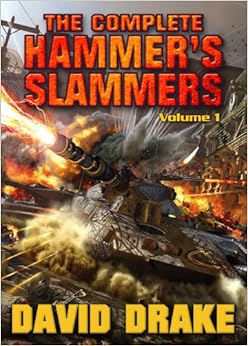
I'm going to be completely honest, and I'm sure my readers will not be at all surprised, that I decided to get this book at the used bookstore based entirely on the cover. I mean, come on, big tank on the front, how was I supposed to resist something like that? You guys know me by now. Based on the cover and the blurb on the back, (as well as it being a Baen Books title) I expected Hammer's Slammers to be some gritty, two-fisted, pulp sci-fi action. While Drake certainly incorporates elements like that into his book, and the stories benefit from his military experiences in Vietnam, the overall result is a little discouraging to say the least. I am a little worried that I'm being a little unfair to Hammer's Slammers and judging it simply because it isn't the Bolo series, something I love very much with a deep and illogical passion. I will try to be as just as possible to this book and resort from simply whining that it doesn't have Bolos.
Structure-wise, this book is a collection of short stories written about Colonel Alois Hammer and his armored mercenary regiment. In Drake's universe civil war and conflict is a regular occurrence, generating a market for companies of highly trained and well-equipped mercenaries. Hammer's Slammers, with their core of 170 tonne battle tanks are the absolute cream of the mercenary crop, and while a government can only afford to hire them for a few months, those months could determine the fate of an entire planet. As a result Colonel Hammer and his men are in great demand and are constantly shifting from one battlefield to another and so a collection of short stories works as a means to tell many different stories across many different battlefields.
The problem that I noticed, at least in the first half of the book, is that the stories felt disjointed and disorganized. I'd finally start understanding what the heck was going on in a story before it'd end abruptly and we'd get shifted to another story. It may have just been that these were chronologically the first stories Drake wrote and so he was still developing his style and technique as a writer, but it made it very hard for me to get into the series. Weirdly enough about halfway through the book I started enjoying the stories more but I noticed the Slammers were often side characters rather than the main focus. I may have to just read the second volume at this point to get a better feel on the series, but I'm definitely left confused more than anything else.
I did have a couple of quibbles technologically, although the merits of debating technology in a sci-fi work where fusion generators are common place and interstellar travel is a routine occurrence may or may not be moot. Specifically the tanks of Hammer's regiment, and really most vehicles as a matter of fact, are all hovercraft that utilize large fans to create a cushion of air that supports the vehicles. Personally, as a fan of vehicles that stay firmly on the ground, this seemed rather impractical as a means of transportation, especially when the characters in the books mention the countless maintenance issues that these hover tanks require just to keep moving. Granted, vehicles with treads or wheels have their own drawbacks, but it feels like less of a headache.
The other big thing that bugged me technologically was the weapons technology. Drake actually includes little essays on various things in his universe like religion, politics, and technology. Pretty much anyone who can get their hands on them uses powerguns, which have zero recoil, are fairly simple to use, and small-arms versions will cut through anything unarmored and most lightly armored targets. The problem I have with powerguns is they're ridiculously complicated devices and the drawbacks seem to outweigh any benefit you'd get from using them. Basically, powerguns run so hot that they include tanks of liquid nitrogen to cool the weapon between rounds to keep the iridium from melting. And even then you can't holster a pistol powergun right away because the barrel still might catch your clothes on fire. Plus, the poweguns use plastic casings on their ammunition so if a gun jams the casing will melt all over the action of the piece, meaning you have to spend time carving the melted plastic away from the action to get the gun working again. (This happens a couple of times in the books, most characters just pick up another weapon.) And, on top of that, the weapons utilize a magnetic technobabble field to release a ton of energy at the enemy, which is awesome, but a slight irregularity in the manufacturing process means the weapon could blow up in your face instead. So powerguns basically can only be made on the most technologically advanced planets and cost an arm and a leg to produce. Yet all the mercenaries use them, and plenty of other people as well. I almost feel like this is an example of Drake over-explaining his awesome new technology which just raises questions about its impracticality. Personally, if he had just left it at "pew-pew, lasers!" I'd have been satisfied. As you can see by the length of this paragraph, the powerguns are probably the single biggest problem I had with this series.
I also noticed a certain amount of amorality with a few of the characters; people who were willing to get the job done, no matter the cost. Of course, that's what you'd expect from a band of mercenaries. They're not really interested in right or wrong or politics, they're just fighting for a paycheck. (And hopefully stay alive long enough to cash said paycheck) This might honestly just be a case of this series not being for me because I take issue with how casually some of the Slammers will kill civilians and prisoners or ignore collateral damage. And that's kind of the point of the Slammers. They're focused on getting the job done, as efficiently and ruthlessly as possible. I'm more a sucker for heroics and noble ideals, so the tone of this series just might not be for me. But this doesn't mean that other people won't enjoy it.
I will say that the stories seemed to be getting better as the book went on and I may have to check out volume two and see if I can get a better feel for the series. I do, however have some pretty serious personal reservations about the series as a whole. However, obviously this series is pretty popular among quite a lot of people so you may find it interesting yourself.
- Kalpar
Structure-wise, this book is a collection of short stories written about Colonel Alois Hammer and his armored mercenary regiment. In Drake's universe civil war and conflict is a regular occurrence, generating a market for companies of highly trained and well-equipped mercenaries. Hammer's Slammers, with their core of 170 tonne battle tanks are the absolute cream of the mercenary crop, and while a government can only afford to hire them for a few months, those months could determine the fate of an entire planet. As a result Colonel Hammer and his men are in great demand and are constantly shifting from one battlefield to another and so a collection of short stories works as a means to tell many different stories across many different battlefields.
The problem that I noticed, at least in the first half of the book, is that the stories felt disjointed and disorganized. I'd finally start understanding what the heck was going on in a story before it'd end abruptly and we'd get shifted to another story. It may have just been that these were chronologically the first stories Drake wrote and so he was still developing his style and technique as a writer, but it made it very hard for me to get into the series. Weirdly enough about halfway through the book I started enjoying the stories more but I noticed the Slammers were often side characters rather than the main focus. I may have to just read the second volume at this point to get a better feel on the series, but I'm definitely left confused more than anything else.
I did have a couple of quibbles technologically, although the merits of debating technology in a sci-fi work where fusion generators are common place and interstellar travel is a routine occurrence may or may not be moot. Specifically the tanks of Hammer's regiment, and really most vehicles as a matter of fact, are all hovercraft that utilize large fans to create a cushion of air that supports the vehicles. Personally, as a fan of vehicles that stay firmly on the ground, this seemed rather impractical as a means of transportation, especially when the characters in the books mention the countless maintenance issues that these hover tanks require just to keep moving. Granted, vehicles with treads or wheels have their own drawbacks, but it feels like less of a headache.
The other big thing that bugged me technologically was the weapons technology. Drake actually includes little essays on various things in his universe like religion, politics, and technology. Pretty much anyone who can get their hands on them uses powerguns, which have zero recoil, are fairly simple to use, and small-arms versions will cut through anything unarmored and most lightly armored targets. The problem I have with powerguns is they're ridiculously complicated devices and the drawbacks seem to outweigh any benefit you'd get from using them. Basically, powerguns run so hot that they include tanks of liquid nitrogen to cool the weapon between rounds to keep the iridium from melting. And even then you can't holster a pistol powergun right away because the barrel still might catch your clothes on fire. Plus, the poweguns use plastic casings on their ammunition so if a gun jams the casing will melt all over the action of the piece, meaning you have to spend time carving the melted plastic away from the action to get the gun working again. (This happens a couple of times in the books, most characters just pick up another weapon.) And, on top of that, the weapons utilize a magnetic technobabble field to release a ton of energy at the enemy, which is awesome, but a slight irregularity in the manufacturing process means the weapon could blow up in your face instead. So powerguns basically can only be made on the most technologically advanced planets and cost an arm and a leg to produce. Yet all the mercenaries use them, and plenty of other people as well. I almost feel like this is an example of Drake over-explaining his awesome new technology which just raises questions about its impracticality. Personally, if he had just left it at "pew-pew, lasers!" I'd have been satisfied. As you can see by the length of this paragraph, the powerguns are probably the single biggest problem I had with this series.
I also noticed a certain amount of amorality with a few of the characters; people who were willing to get the job done, no matter the cost. Of course, that's what you'd expect from a band of mercenaries. They're not really interested in right or wrong or politics, they're just fighting for a paycheck. (And hopefully stay alive long enough to cash said paycheck) This might honestly just be a case of this series not being for me because I take issue with how casually some of the Slammers will kill civilians and prisoners or ignore collateral damage. And that's kind of the point of the Slammers. They're focused on getting the job done, as efficiently and ruthlessly as possible. I'm more a sucker for heroics and noble ideals, so the tone of this series just might not be for me. But this doesn't mean that other people won't enjoy it.
I will say that the stories seemed to be getting better as the book went on and I may have to check out volume two and see if I can get a better feel for the series. I do, however have some pretty serious personal reservations about the series as a whole. However, obviously this series is pretty popular among quite a lot of people so you may find it interesting yourself.
- Kalpar
Thursday, March 26, 2015
Black Mirror
This week I'm going to do something a little different and talk about a tv show which (as of late March 2015) is currently available for viewing on Netflix. This show is called Black Mirror, and as is typical of British shows is fairly short, containing a total of just six episodes. (Well, apparently seven but there's only six on Netflix at the moment.) And while I'll be perfectly honest that I don't care for one or maybe two of these episodes, the rest are incredibly fantastic and in my case left me thinking about them for the rest of the day, or even the rest of the week.
Black Mirror is a science-fiction anthology show, much in the same vein as The Twilight Zone, which is probably one of my favorite TV shows. I say science-fiction although some of the stories could happen with existing technology, but most of the stories have a definite science-fiction element to them. However the creators (mainly Charlie Brooker) utilize their stories to make commentary about society today, again very much in the vein of The Twilight Zone. And it's very easy for social commentary to get a little heavy-handed, and that sort of leaks through in a couple of episodes, but at the same time it's really thought-provoking and interesting. And perhaps, in forty or fifty years some of the episodes will be just as dated as some of the more Cold War-oriented Twilight Zone episodes will be, but I like to think that maybe a couple will become timeless classics as well.
As an anthology series, each episode contains its own story, but overall there's definitely a rather dark theme to the series. It tackles various subjects such as human infatuation with media, our relationship with technology, grief and loss, crime, and politics. And overall the episodes are really good because they left me thinking about them throughout the day. Even enough for me to write a blog post about them and tell people they should go watch this show as well. Even if the episode seems a little bit off the mark, it's something that you can talk about. And that's probably one of the greatest powers of tv as a medium, the ability to get us to think and talk about subjects that may not normally cross our minds. That's the power of any medium, really, and tv has definitely made attempts to get us to think about things, but very often shows are just about entertainment. Black Mirror is one of those gems that manages to do both, and I think more people should check it out.
If any of my readers are fans of The Twilight Zone, which I'm going to take a flying leap and guess that they probably are, then I highly recommend that they go and check out Black Mirror. I guarantee you won't be disappointed. (Just don't get turned off by the first episode, okay?)
- Kalpar
Black Mirror is a science-fiction anthology show, much in the same vein as The Twilight Zone, which is probably one of my favorite TV shows. I say science-fiction although some of the stories could happen with existing technology, but most of the stories have a definite science-fiction element to them. However the creators (mainly Charlie Brooker) utilize their stories to make commentary about society today, again very much in the vein of The Twilight Zone. And it's very easy for social commentary to get a little heavy-handed, and that sort of leaks through in a couple of episodes, but at the same time it's really thought-provoking and interesting. And perhaps, in forty or fifty years some of the episodes will be just as dated as some of the more Cold War-oriented Twilight Zone episodes will be, but I like to think that maybe a couple will become timeless classics as well.
As an anthology series, each episode contains its own story, but overall there's definitely a rather dark theme to the series. It tackles various subjects such as human infatuation with media, our relationship with technology, grief and loss, crime, and politics. And overall the episodes are really good because they left me thinking about them throughout the day. Even enough for me to write a blog post about them and tell people they should go watch this show as well. Even if the episode seems a little bit off the mark, it's something that you can talk about. And that's probably one of the greatest powers of tv as a medium, the ability to get us to think and talk about subjects that may not normally cross our minds. That's the power of any medium, really, and tv has definitely made attempts to get us to think about things, but very often shows are just about entertainment. Black Mirror is one of those gems that manages to do both, and I think more people should check it out.
If any of my readers are fans of The Twilight Zone, which I'm going to take a flying leap and guess that they probably are, then I highly recommend that they go and check out Black Mirror. I guarantee you won't be disappointed. (Just don't get turned off by the first episode, okay?)
- Kalpar
Thursday, March 19, 2015
Im Memoriam: Sir Terry Pratchett and Discworld
For those that know me, the Discworld series has been incredibly important in my life. Heck, I've written reviews about not only main Discworld books, but also an illustrated novel, and the young adult stories as well, probably in some hope that someone else out there, reading my blog, who hasn't picked up these books yet will. Discworld is important on so many levels. Something I've noticed is that many people who read usually have at least one book, something that hit them the right way at the right time and spoke to their very soul, the very essence of their being. A book that has somehow shaped who they are as a person and how they view life. I am very fortunate in that I cannot point to just one book that has influenced me in such a way, but an entire series.
My experience with Discworld began ages ago when I was a sophomore in college. My friend Brendan, who shares a great many interests to me as I do, one day passed a book onto me titled Small Gods. Being someone who tries to read books loaned to me in a timely manner, and finding myself with a little free time between classes I started reading it. And kept reading it, finding it incredibly compelling and incredibly difficult to put down. I am by my own admission, a fairly fast reader, but it has often been very rare for me to find a book that just grabbed me by, for lack of a better term, the soul and made me want to keep reading. I cannot recall exactly how quickly I read Small Gods, but I'm certain it was no more than a matter of days. Brendan soon afterward loaned me Night Watch, which has become one of my favorite books, and that summer I started collecting Discworld books like crazy. By my start of junior year I had a respectable collection. Within two years I had nearly all of them. I actually made it a goal to read all the main Discworld books by the time Snuff came out late in 2011. And while there are certain books in the series I don't care for, and certain books that I cherish, overall I would say Discworld has had a positive impact on my life. If nothing else than because one person decided to be my friend because, "He's sitting over there reading a Pratchett book, he seems interesting."
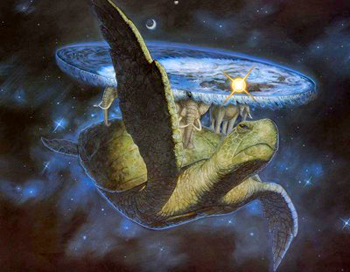
Because Discworld has long since gone beyond just being a satirical take on well-worn fantasy tropes. It certainly started that way in Colour of Magic, but it grew and became so much more over the years. Pratchett has tackled topics as divisive as politics and religion, commented on economics and law, and some would argue that he has created a modern school of philosophy through the lens of fantasy. And yes, they are silly stories about a world on the backs of four elephants on the back of a turtle, but at the same time they're stories about people as well, and as I'm sure Pratchett himself would say, one of the most powerful ways to shape people is through stories. Whether it be stories about the long and distant past, stories about the here and now, or stories about life on the Disc, when stories are about people they have the ability to shape people, for better or worse, and that's an incredible power.
So what have I learned from the five or so years I've spent exploring the Disc? Essentially, people are people. We can be downright selfish and terrible, or charitable to a fault and good. Sometimes within the same day. And maybe you can't solve all the world's problems. But the important thing is to give your best and try. And while it's sad that Pratchett has passed on, he will remain with us in his dozens of books, and hopefully influence generations of people, and how they think, for the better.
- Kalpar
My experience with Discworld began ages ago when I was a sophomore in college. My friend Brendan, who shares a great many interests to me as I do, one day passed a book onto me titled Small Gods. Being someone who tries to read books loaned to me in a timely manner, and finding myself with a little free time between classes I started reading it. And kept reading it, finding it incredibly compelling and incredibly difficult to put down. I am by my own admission, a fairly fast reader, but it has often been very rare for me to find a book that just grabbed me by, for lack of a better term, the soul and made me want to keep reading. I cannot recall exactly how quickly I read Small Gods, but I'm certain it was no more than a matter of days. Brendan soon afterward loaned me Night Watch, which has become one of my favorite books, and that summer I started collecting Discworld books like crazy. By my start of junior year I had a respectable collection. Within two years I had nearly all of them. I actually made it a goal to read all the main Discworld books by the time Snuff came out late in 2011. And while there are certain books in the series I don't care for, and certain books that I cherish, overall I would say Discworld has had a positive impact on my life. If nothing else than because one person decided to be my friend because, "He's sitting over there reading a Pratchett book, he seems interesting."
Because Discworld has long since gone beyond just being a satirical take on well-worn fantasy tropes. It certainly started that way in Colour of Magic, but it grew and became so much more over the years. Pratchett has tackled topics as divisive as politics and religion, commented on economics and law, and some would argue that he has created a modern school of philosophy through the lens of fantasy. And yes, they are silly stories about a world on the backs of four elephants on the back of a turtle, but at the same time they're stories about people as well, and as I'm sure Pratchett himself would say, one of the most powerful ways to shape people is through stories. Whether it be stories about the long and distant past, stories about the here and now, or stories about life on the Disc, when stories are about people they have the ability to shape people, for better or worse, and that's an incredible power.
So what have I learned from the five or so years I've spent exploring the Disc? Essentially, people are people. We can be downright selfish and terrible, or charitable to a fault and good. Sometimes within the same day. And maybe you can't solve all the world's problems. But the important thing is to give your best and try. And while it's sad that Pratchett has passed on, he will remain with us in his dozens of books, and hopefully influence generations of people, and how they think, for the better.
- Kalpar
Thursday, March 12, 2015
Bolo Strike, by William H. Keith, Jr.
Hey, look, Kalpar's reviewing another one of the Bolo books. Is anyone surprised in the least? Anyone at all? No? Okay, good. On with the review.
So I'm continuing my march through the full-length Bolo novels and actually coming towards the end of my endeavor. This particular book, Bolo Strike, is another production of William H. Keith, Jr. and is set some five hundred years after the fall of the Concordiat of Man and the end of the Final War with the Melconians. A new human government known as the Confederation has once again emerged and continues to use the redoubtable Mark XXXIII Bolos. In this particular instance a human-colonized world known as Caern has recently been rediscovered by Confederacy traders. However, the humans of Caern worship and are ruled by an alien species known as the Aetryx whom they venerate as gods. The exact relationship between humans and Aetryx is never really understood, but the Confederacy decides that no outpost of humanity, no matter how small, is going to be ruled by alien life forms and creates a task force to liberate the human population, including dozens of Mark XXXIII Bolos. However, the invasion does not go as planned, especially when the Aetryx begin sending Mark XXXII Bolos at the Confederation forces. Although outdated and unequal in firepower to a XXXIII, the XXXII's pose a significant threat in numbers, especially because if nothing else it means the Aetryx have been able to override the security protocols in a Bolo's programming.
The action in this book is all the glorious pulp I've come to this series, but it actually takes a back seat to some of the questions that are raised in this series, specifically what it means to be human and what counts as human. In the universe of this particular book, although it's definitely possible for a complete human mind to be copied and downloaded into a computer, humans almost universally see it not as immortality but as an illegitimate copy. That somehow that electronic copy of yourself is inherently less valuable than the flesh and blood version. And there's not really any debate on this point either, it's strongly outlined in black and white. Personally I feel like it raises an interesting question and a dilemma, especially when there are several copies of one person's memories running around, all convinced they're the original. I just wish the rationale behind an electronic copy not counting came to more than because it's not the original. Maybe it's a little much to expect a deep and thoughtful discussion about something like this in what's essentially a silly pulp novel, but pulp novels can talk about serious stuff too.
Another question I found myself asking was if the humans were really any better than the Aetryx, which was something that came up in Book Six: Cold Steel. As my readers may remember, that book dealt with the Tersae, a race of warriors who had been genetically engineered by their creators and forced into fighting humanity, a rather losing proposition when Bolos are involved. The question becomes are the humans really any better in creating mechanical monstrosities and then sending them into battle to fight and die for our needs, only to put them back into storage when the war's over and there's no need for them anymore? When the Aetryx do something similar to their human followers, it casts them forever as the villains, but it really just made me wonder if what humanity does to the Bolos is really fair. After all, these are fully self-aware beings. Who mass several thousand tons and are bristling with weapons, but self-aware nonetheless. And yet the Bolos are seldom to never given a say, and in fact can never feel things which we don't want them to feel because their programming simply doesn't include it. Humanity's treatment of its strongest protectors feels inherently unfair to me, but it's never really explored. And perhaps it can't be because Bolos can't see their relationship with humanity as anything other than proper because they're programed to be that way. It raises a lot of questions but never really gets a proper treatment.
Other than the questions I have, this book is all right. I don't have any serious complaints about it, but by this point in the series it's starting to just blend in with a lot of the other books. The challenge with the Bolo series is probably keeping it fresh because there's only so many tank battles you can do before you have to come up with something original. And this may be why I suspect the series ends eventually, because most of the ideas are exhausted and there's just no new ground to cover.
- Kalpar
So I'm continuing my march through the full-length Bolo novels and actually coming towards the end of my endeavor. This particular book, Bolo Strike, is another production of William H. Keith, Jr. and is set some five hundred years after the fall of the Concordiat of Man and the end of the Final War with the Melconians. A new human government known as the Confederation has once again emerged and continues to use the redoubtable Mark XXXIII Bolos. In this particular instance a human-colonized world known as Caern has recently been rediscovered by Confederacy traders. However, the humans of Caern worship and are ruled by an alien species known as the Aetryx whom they venerate as gods. The exact relationship between humans and Aetryx is never really understood, but the Confederacy decides that no outpost of humanity, no matter how small, is going to be ruled by alien life forms and creates a task force to liberate the human population, including dozens of Mark XXXIII Bolos. However, the invasion does not go as planned, especially when the Aetryx begin sending Mark XXXII Bolos at the Confederation forces. Although outdated and unequal in firepower to a XXXIII, the XXXII's pose a significant threat in numbers, especially because if nothing else it means the Aetryx have been able to override the security protocols in a Bolo's programming.
The action in this book is all the glorious pulp I've come to this series, but it actually takes a back seat to some of the questions that are raised in this series, specifically what it means to be human and what counts as human. In the universe of this particular book, although it's definitely possible for a complete human mind to be copied and downloaded into a computer, humans almost universally see it not as immortality but as an illegitimate copy. That somehow that electronic copy of yourself is inherently less valuable than the flesh and blood version. And there's not really any debate on this point either, it's strongly outlined in black and white. Personally I feel like it raises an interesting question and a dilemma, especially when there are several copies of one person's memories running around, all convinced they're the original. I just wish the rationale behind an electronic copy not counting came to more than because it's not the original. Maybe it's a little much to expect a deep and thoughtful discussion about something like this in what's essentially a silly pulp novel, but pulp novels can talk about serious stuff too.
Another question I found myself asking was if the humans were really any better than the Aetryx, which was something that came up in Book Six: Cold Steel. As my readers may remember, that book dealt with the Tersae, a race of warriors who had been genetically engineered by their creators and forced into fighting humanity, a rather losing proposition when Bolos are involved. The question becomes are the humans really any better in creating mechanical monstrosities and then sending them into battle to fight and die for our needs, only to put them back into storage when the war's over and there's no need for them anymore? When the Aetryx do something similar to their human followers, it casts them forever as the villains, but it really just made me wonder if what humanity does to the Bolos is really fair. After all, these are fully self-aware beings. Who mass several thousand tons and are bristling with weapons, but self-aware nonetheless. And yet the Bolos are seldom to never given a say, and in fact can never feel things which we don't want them to feel because their programming simply doesn't include it. Humanity's treatment of its strongest protectors feels inherently unfair to me, but it's never really explored. And perhaps it can't be because Bolos can't see their relationship with humanity as anything other than proper because they're programed to be that way. It raises a lot of questions but never really gets a proper treatment.
Other than the questions I have, this book is all right. I don't have any serious complaints about it, but by this point in the series it's starting to just blend in with a lot of the other books. The challenge with the Bolo series is probably keeping it fresh because there's only so many tank battles you can do before you have to come up with something original. And this may be why I suspect the series ends eventually, because most of the ideas are exhausted and there's just no new ground to cover.
- Kalpar
Thursday, March 5, 2015
Flag in Exile, by David Weber
A Warning to my dear and gentle readers: Once again I am returning to the Honor Harrington series by David Weber. As I mentioned in my last review Field of Dishonor, this series has started to get complicated to the point it becomes very difficult to avoid spoilers entirely. I shall do my best to avoid them as much as possible, however read ahead at your own risk.
Much to no one's surprise, I am sure, I have returned to a definite favorite of mine, the space opera series of Honor Harrington, with the fifth installment Flag in Exile. (Hard to believe, I'm already five books in. It's a little bit crazy) Anyway, when we last left our protagonist, Honor had been put on half-pay and beached by the Royal Manticore Navy in response to all the political hub-bub caused by her duel with Lord Pavel Young. Honor retires to oversee her estate on Grayson, but the war between Manticore and Haven is beginning to reach a deadlock and the Navy can't keep Honor beached forever. In the meantime, though, Protector Benjamin IX of Grayson offers Honor a commission as an admiral in Grayson's own Navy due to their lack of experienced officers. But how Honor will respond to her first opportunity at flag rank remains to be seen.
In addition to Honor getting bumped up to flag rank there's an ongoing plot about the internal struggles that are still rocking Grayson in response to Protector Benjamin's reforms, as well as the appointment of Honor Harrington to the office of steadholder, the first female to hold such a post. I rather liked this plot because it showed how Grayson is developing and how there are still problems to be overcome on that planet. It makes Grayson appear more complex than simply a one-dimensional Planet of Hats, which you often see in space operas, and shows that Honor's actions in The Honor of the Queen haven't solved everything for forever either. Although it's certainly frustrating to see a bunch of religious fanatics trying to prevent reform and change, (something that's frustrating to me even in real life), it certainly makes for a far more believable planet with varied political and religious opinions.
I will say the cover of the book kind of gave one of the most epic parts of the book away. Instead of some of the more generic covers with Honor and Nimitz we've seen in the past, we now know that Honor's totally going to get into an epic sword fight at some point during the book. Building up to that point was pretty awesome but the fight was surprisingly short compared to how it takes precedence on the cover. But then again, what do I know about cover art? However, there are still some pretty epic and awesome things in this book, even if it makes Honor look freaking invincible compared to all the stuff she's gone through. But I'm sort of okay with that. This is an unapologetic space opera, and that's exactly what I signed on for.
Of course, in addition to all the stuff happening dirt-side that Honor has to deal with, that pesky war between Manticore and Haven has to come back into the plot again. Of course as the saying goes, if Honor cannot come to the war, then the war must come to Honor. Weber kind of spends some time trying to misdirect us about what exactly the People's Republic of Haven is up to with Operations Stalking Horse and Dagger, but I didn't buy it. It was sort of like, "Come on, Dave. You made Honor an admiral in this book for a reason. Just let the Haven fleet show up in Yeltsin already so she can fight them." So although it may take Honor by surprise, I was more, "Finally, let's get this space battle on already." That is sort of a weakness I'll admit, between the cover and the most elementary understanding of how these books work there isn't terribly much of a surprise for the reader. But do you want awesome space battles and sweet sword duels or not? Because I totally do.
As I said, I think the real strength of this installment is showing how Grayson has developed as a planet and making it more three dimensional overall. I will say that compared to the previous novel, Honor kind of takes a back seat, especially since she's still sort of shut down emotionally from all the trauma, which is understandable for anyone in her position. I do hope that Honor can develop more as a character and most likely the Royal Manticore Navy will call her back to duty in the next book.
- Kalpar
Much to no one's surprise, I am sure, I have returned to a definite favorite of mine, the space opera series of Honor Harrington, with the fifth installment Flag in Exile. (Hard to believe, I'm already five books in. It's a little bit crazy) Anyway, when we last left our protagonist, Honor had been put on half-pay and beached by the Royal Manticore Navy in response to all the political hub-bub caused by her duel with Lord Pavel Young. Honor retires to oversee her estate on Grayson, but the war between Manticore and Haven is beginning to reach a deadlock and the Navy can't keep Honor beached forever. In the meantime, though, Protector Benjamin IX of Grayson offers Honor a commission as an admiral in Grayson's own Navy due to their lack of experienced officers. But how Honor will respond to her first opportunity at flag rank remains to be seen.
In addition to Honor getting bumped up to flag rank there's an ongoing plot about the internal struggles that are still rocking Grayson in response to Protector Benjamin's reforms, as well as the appointment of Honor Harrington to the office of steadholder, the first female to hold such a post. I rather liked this plot because it showed how Grayson is developing and how there are still problems to be overcome on that planet. It makes Grayson appear more complex than simply a one-dimensional Planet of Hats, which you often see in space operas, and shows that Honor's actions in The Honor of the Queen haven't solved everything for forever either. Although it's certainly frustrating to see a bunch of religious fanatics trying to prevent reform and change, (something that's frustrating to me even in real life), it certainly makes for a far more believable planet with varied political and religious opinions.
I will say the cover of the book kind of gave one of the most epic parts of the book away. Instead of some of the more generic covers with Honor and Nimitz we've seen in the past, we now know that Honor's totally going to get into an epic sword fight at some point during the book. Building up to that point was pretty awesome but the fight was surprisingly short compared to how it takes precedence on the cover. But then again, what do I know about cover art? However, there are still some pretty epic and awesome things in this book, even if it makes Honor look freaking invincible compared to all the stuff she's gone through. But I'm sort of okay with that. This is an unapologetic space opera, and that's exactly what I signed on for.
Of course, in addition to all the stuff happening dirt-side that Honor has to deal with, that pesky war between Manticore and Haven has to come back into the plot again. Of course as the saying goes, if Honor cannot come to the war, then the war must come to Honor. Weber kind of spends some time trying to misdirect us about what exactly the People's Republic of Haven is up to with Operations Stalking Horse and Dagger, but I didn't buy it. It was sort of like, "Come on, Dave. You made Honor an admiral in this book for a reason. Just let the Haven fleet show up in Yeltsin already so she can fight them." So although it may take Honor by surprise, I was more, "Finally, let's get this space battle on already." That is sort of a weakness I'll admit, between the cover and the most elementary understanding of how these books work there isn't terribly much of a surprise for the reader. But do you want awesome space battles and sweet sword duels or not? Because I totally do.
As I said, I think the real strength of this installment is showing how Grayson has developed as a planet and making it more three dimensional overall. I will say that compared to the previous novel, Honor kind of takes a back seat, especially since she's still sort of shut down emotionally from all the trauma, which is understandable for anyone in her position. I do hope that Honor can develop more as a character and most likely the Royal Manticore Navy will call her back to duty in the next book.
- Kalpar
Subscribe to:
Comments (Atom)